
If your Florida home runs on a private well, you are the water utility: the EPA's Safe Drinking Water Act does not cover private wells, so no agency tests or treats your water for you. More than 43 million Americans rely on domestic wells, according to the U.S. Geological Survey. This guide explains what Florida groundwater typically carries, what to test, and how a complete treatment system is built.
Who is responsible for well water quality in Florida?
You are. The EPA states it plainly: the Safe Drinking Water Act regulates public water systems and does not apply to privately owned individual wells. The Florida Department of Health offers guidance and testing programs for well owners, but no government agency monitors your tap, schedules your tests, or installs your treatment. The USGS estimates that more than 43 million people nationwide drink from domestic wells, each household effectively operating its own tiny utility.
That responsibility is manageable, hundreds of thousands of Florida families handle it well. It rests on two habits: testing on a schedule and treating based on results. Everything else in this guide hangs on those two habits.
What is actually in Florida well water?
Most Florida wells draw from the Floridan aquifer system or the shallower surficial aquifers above it. The USGS describes the Floridan as one of the most productive aquifer systems in the world, supplying drinking water to roughly 10 million people. It is also a karst limestone system, and that geology writes the recipe for what comes out of your tap:
| Constituent | Where it comes from | What it does |
|---|---|---|
| Hardness (calcium, magnesium) | Dissolved limestone | Scale on fixtures and heaters, dry skin and hair, soap that will not lather |
| Hydrogen sulfide (H2S) | Sulfur-reducing bacteria, sulfur minerals | Rotten egg odor, corroded metal plumbing |
| Iron and manganese | Natural deposits in soil and rock | Orange, brown and black stains; metallic taste |
| Tannins | Decaying vegetation, common in shallow wells | Tea-colored water, yellow staining |
| Sediment | Sand and fine particles from the formation | Cloudy water, abrasive wear on valves and appliances |
| Coliform bacteria | Surface intrusion, flooding, well defects | Indicator that pathogens can reach the water; health relevant |
| Nitrates | Fertilizers, septic systems, animal waste | Health risk above 10 mg/L (EPA primary limit), especially for infants |
| Low pH (acidic water) | Shallow, low-mineral groundwater | Corrodes plumbing, can leach copper and lead, blue-green stains |
Notice the split: most entries are nuisance problems you can see, smell or taste, while the two that matter most for health, bacteria and nitrates, are completely invisible. That asymmetry is the core argument for testing.
What should you test for, and how often?
The CDC's guidance for private well owners is concrete: test at least once a year for total coliform bacteria, nitrates, total dissolved solids and pH, and test more often when something changes. The Florida Department of Health adds state-specific triggers:
- Annually: bacteria (total coliform / E. coli) and nitrates, plus TDS and pH.
- After any flood event or whenever the wellhead was submerged.
- After well repairs or replacement of the pump or pressure tank.
- When taste, odor or color changes suddenly.
- When a new baby, pregnancy or immunocompromised person joins the household, nitrates and bacteria matter most for them.
- Before buying a home with a well, as part of due diligence.
For treatment design you also want the nuisance panel, hardness, iron, manganese and sulfur, because those numbers size the equipment. A free in-home water test covers that panel on the spot, and lab testing through your county health department covers the health parameters.

What warning signs can you see, smell or taste?
Your senses are a legitimate first-line screening tool for nuisance issues:
| Symptom | Likely cause | Where to go deeper |
|---|---|---|
| Rotten egg smell | Hydrogen sulfide / sulfur bacteria | Sulfur odor guide |
| Orange or brown stains | Iron, manganese, iron bacteria | Iron stains guide |
| White crust on faucets, spots on glass | Hardness (calcium and magnesium) | Well water treatment |
| Cloudy or gritty water | Sediment, sand | Sediment pre-filtration |
| Yellow or tea-colored water | Tannins | Tannin-specific media |
| Blue-green stains under drips | Acidic water corroding copper | pH neutralization |
| No symptom at all | Bacteria and nitrates are invisible | Annual lab testing |
How does a complete well water treatment system work?
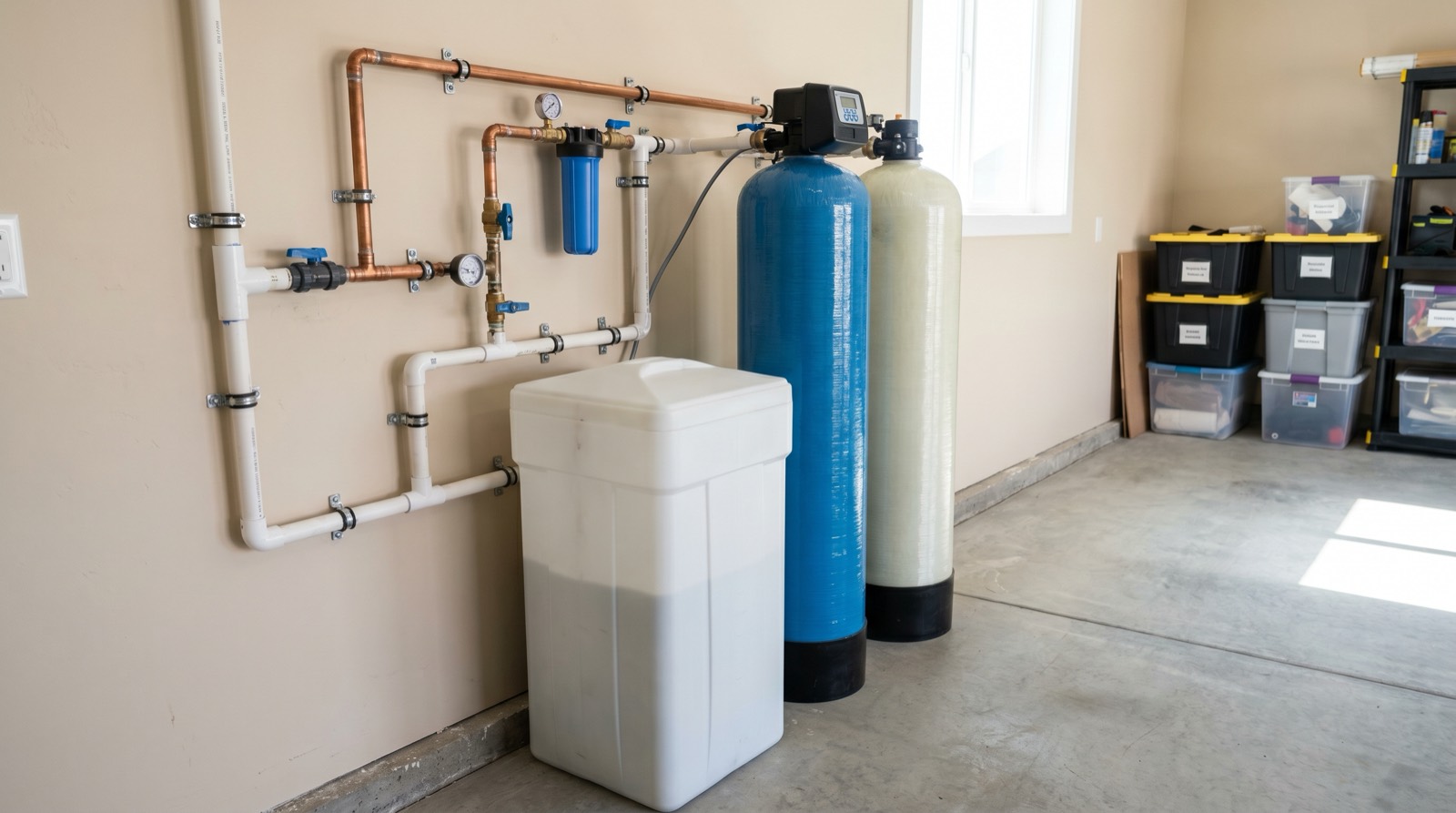
Well treatment is a train of stages, each solving one class of problem, in an order that protects the stages downstream. A complete Florida configuration looks like this, with stages included or omitted based on the test:
- Sediment pre-filtration. Removes sand and particles so they do not abrade or clog everything that follows.
- Oxidation. Air injection or controlled chlorination converts dissolved iron and hydrogen sulfide into filterable solids, and disinfects when chlorine is used.
- Iron / sulfur filtration. Catalytic media captures the oxidized particles, ending stains and odor.
- Softening (ion exchange). Removes calcium and magnesium hardness, protecting the water heater, appliances, skin and hair.
- Activated carbon. Polishes taste and odor and removes the chlorine introduced upstream.
- UV disinfection. A physical barrier against bacteria, applied when testing or well conditions indicate microbial risk.
- Optional reverse osmosis at the kitchen tap for the water the family drinks, an extra polishing layer on top of whole-house treatment.
Our well water page shows how Prevent Water assembles this train for Florida homes, sized to the chemistry found at your tap.
What about hurricanes and flooding?
Florida adds one chapter most states skip. The CDC and the Florida Department of Health are unambiguous: if floodwater covered or reached your wellhead, assume the well is contaminated. Do not drink the water until the well has been disinfected and a bacteriological test comes back clean. County health departments typically offer free or low-cost bacteria testing after declared flood events.
- Use bottled or boiled water until cleared by a test.
- Have the well shock chlorinated, or follow the Florida DOH disinfection procedure.
- Retest for total coliform and E. coli before returning to normal use.
- Inspect the well cap and casing for damage that let surface water in.
Frequently asked questions about Florida well water
Is Florida well water safe to drink?
It can be, but safety is verified, not assumed. The most common Florida well issues, hardness, sulfur odor and iron, are aesthetic, while the ones that matter for health, coliform bacteria and nitrates, are invisible and tasteless. The CDC recommends testing private wells at least once a year precisely because safe and unsafe well water can look identical.
Do I need treatment if my water looks and tastes fine?
Looks and taste only screen for nuisance problems. Bacteria, nitrates and low pH produce no visible signal, and corrosive water can quietly leach copper and lead from plumbing for years. A test answers the question with numbers, and if everything truly is fine, the test simply confirms it.
How long does a well water treatment system last?
With maintenance, the tanks and valves of quality systems commonly serve for many years, while consumables follow their own schedules: sediment cartridges in months, filter media and resin in years, UV lamps annually per manufacturer guidance. The real lifespan driver is matching the system to the water chemistry from the start.
Can I just install a filter pitcher or an under-sink filter instead?
Point-of-use filters treat one faucet, useful for drinking water polishing, but well problems like iron staining, sulfur odor, sediment and bacteria affect every fixture, the water heater and every appliance. That is why well homes are treated at the point of entry, where water first enters the house.
How do I find out what my well actually needs?
Start with a complete water test that covers hardness, iron, manganese, pH, sulfur odor, total dissolved solids and bacteria indicators. Prevent Water performs this analysis free at your home in about 20 minutes, and the result tells you exactly which treatment stages your water does and does not need.
Sources
- U.S. Environmental Protection Agency. Private Drinking Water Wells, regulatory scope of the Safe Drinking Water Act. epa.gov/privatewells
- U.S. Geological Survey. Domestic (Private) Supply Wells, estimate of more than 43 million people served. usgs.gov
- U.S. Geological Survey. Floridan Aquifer System, extent and population served. usgs.gov
- Centers for Disease Control and Prevention. Private Wells, testing frequency and parameters. cdc.gov
- Florida Department of Health. Private Well Testing, state guidance and county programs. floridahealth.gov
- U.S. Environmental Protection Agency. National Primary Drinking Water Regulations (nitrate 10 mg/L) and Secondary Standards (iron, manganese, sulfate, pH). epa.gov
- University of Florida IFAS Extension. Publications on private well water quality and treatment in Florida. edis.ifas.ufl.edu