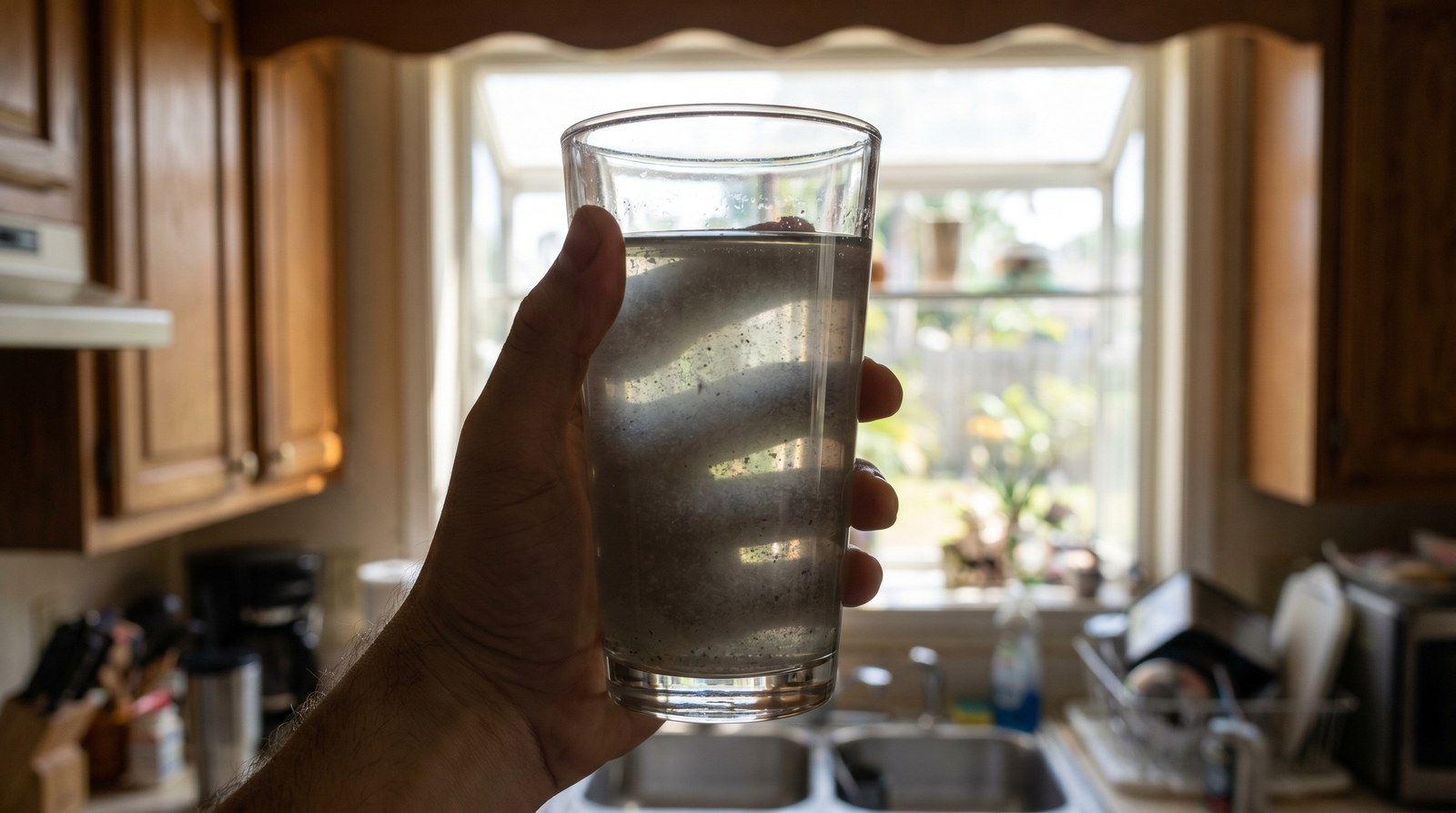
Cloudy well water is almost always suspended sediment: sand, silt, clay or rust particles carried in from the aquifer or shed by aging plumbing. The EPA flags turbidity as a secondary, aesthetic concern at 5 NTU. It is rarely toxic on its own, but it wears out fixtures and can shelter bacteria from disinfection, so it is worth clearing.
Why is my well water cloudy in the first place?
Clear water lets light pass straight through. When water turns cloudy, hazy or milky, something is scattering that light, and in well water that something is almost always tiny solid particles held in suspension. Scientists measure this scattering as turbidity, reported in Nephelometric Turbidity Units (NTU). The USGS describes turbidity simply as the cloudiness of water caused by suspended particles, and the higher the particle load, the murkier the glass.
For a Florida homeowner the practical question is which particles, and where they come from. Private wells draw straight from the ground with no treatment plant in between, so whatever the aquifer carries, sand from the formation, silt stirred up by rain, fine limestone, or oxidized iron, can arrive at your tap. Aging pipes and water heaters add their own flakes of scale and rust. The good news: nearly every cause is physical, which means it can be filtered.
What are the four sources of sediment in well water?
Cloudy water has a short list of usual suspects, and telling them apart points you to the right fix:
| Source | What you see | Likely cause |
|---|---|---|
| Sand and grit | Gritty particles that settle fast, sometimes audible in fixtures | Well screen, pump set too low, or a failing well drawing from the formation |
| Silt and clay | Fine haze that settles slowly or stays suspended | Surface water intrusion, rain, flooding, or a shallow aquifer |
| Iron and rust | Reddish-brown tint, orange particles, staining | Dissolved iron oxidizing on contact with air, or corroding pipes |
| Trapped air | Milky white that clears bottom-up in minutes | Air in the line; harmless, not sediment at all |
Iron deserves a note, because it straddles two of our other articles. Dissolved iron is invisible in the glass until it meets air and oxidizes into orange particles, the same chemistry behind the orange and brown stains on tubs and laundry. If your cloudiness has a rusty tint, you are likely looking at an iron problem wearing a sediment costume.
Is cloudy well water safe to drink?
Sediment itself, sand, silt and clay, is generally not toxic, and the EPA classes turbidity as a secondary standard set for appearance rather than direct health. But there are two real reasons not to shrug it off. First, the EPA notes that high turbidity can interfere with disinfection and provide a medium for microbial growth, because particles physically shield bacteria and viruses from chlorine or UV. Cloudy water is therefore a flag worth pairing with a bacteria test.
Second, the source matters as much as the particle. If silt is arriving because surface water is reaching a shallow well after rain or flooding, the same open pathway can carry coliform bacteria. That overlap is exactly why a positive coliform test and a sudden bout of cloudiness sometimes show up together after a storm.
How do you diagnose what is making your water cloudy?
Work from cheap and simple toward precise:
- The glass test. Fill a clear glass and let it stand. Bottom-up clearing in minutes means air. A settling layer of grit means sediment. A reddish tint that deepens as it sits means iron.
- Check the timing. Cloudiness only after heavy use suggests the pump is drawing the water table down and pulling sand. Cloudiness after rain suggests surface intrusion. Constant cloudiness suggests a steady load.
- Inspect the visible system. Grit in faucet aerators and at the bottom of the toilet tank confirms particulate sediment moving through the whole house.
- Test the water. A turbidity reading plus a standard private-well panel, iron, total coliform, pH and hardness, turns guesses into a treatment plan. Florida DOH and UF/IFAS both recommend testing private wells rather than relying on appearance.
How do you fix cloudy well water for good?
The fix follows the diagnosis. The goal is to stop the particles before they reach your fixtures and to address the source if the water is arriving cloudy from the ground:
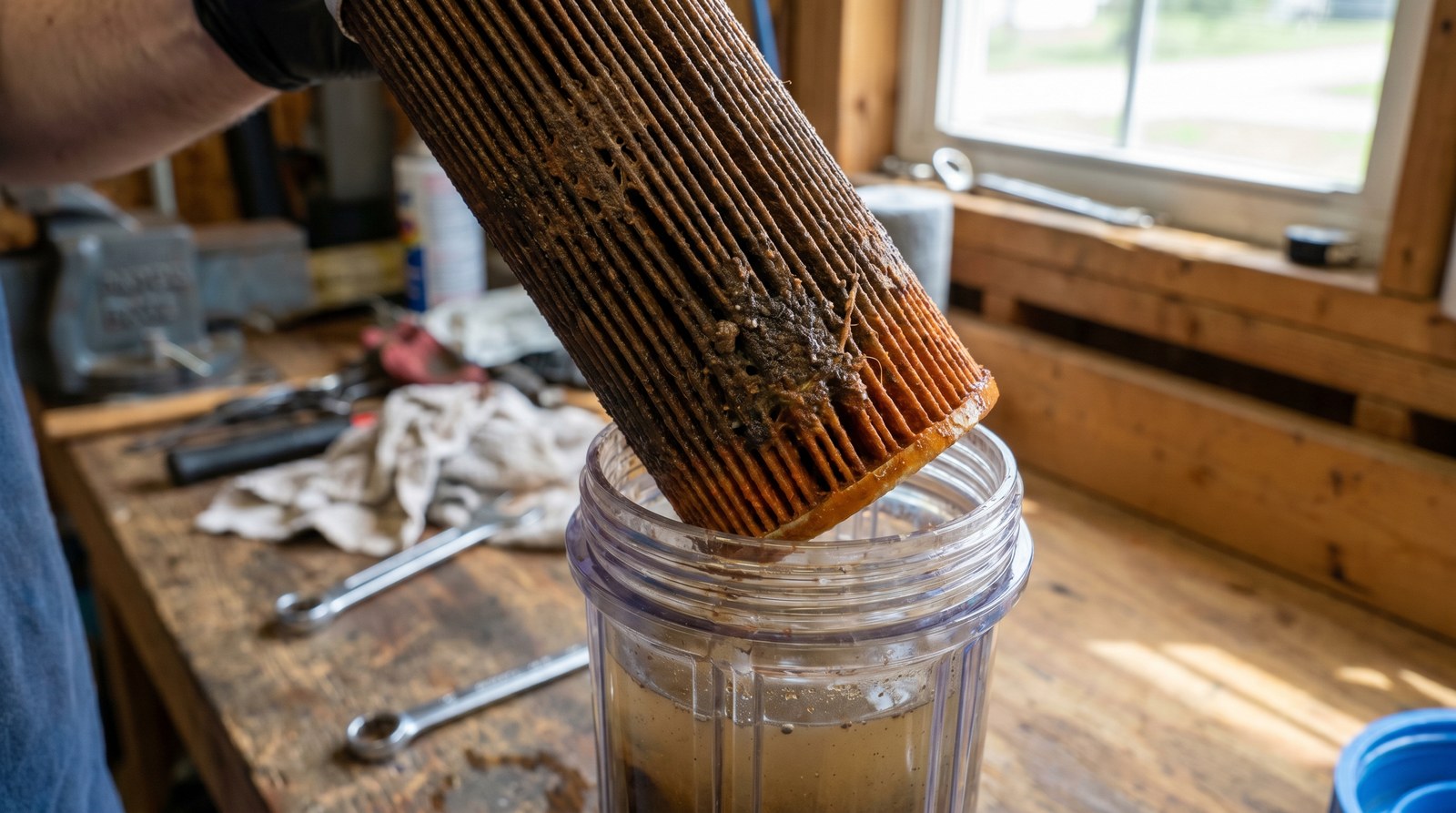
- Whole-house sediment filtration. A correctly sized filter at the point of entry is the workhorse. For mixed particle sizes, treatment is often staged: a coarse filter or a spin-down separator catches sand first, then a finer cartridge polishes out silt. Sizing the micron rating to your actual particles is why the test comes first.
- Iron treatment, if iron is the culprit. Dissolved iron needs to be oxidized and removed by an iron filter, not just screened, since the particles form after the water meets air. The mechanics are covered in our complete Florida well water guide.
- Fix the well, if the source is the well. Sand from a screen problem, a pump set too deep, or surface intrusion through a damaged cap calls for a licensed well contractor. Filtering downstream of a structural problem just loads cartridges faster.
Sediment rarely travels alone in Florida groundwater. It tends to arrive with iron, hardness or sulfur, which is why a single point-of-entry system is usually built to handle several issues at once. The honest first step is knowing what is actually in your water. Our well water treatment page explains how the free in-home test reads turbidity and the rest of the picture in about twenty minutes. The related problems of acidic water and iron bacteria often hide behind cloudy water too.
Frequently asked questions about cloudy well water
Why does my well water turn cloudy only sometimes?
Intermittent cloudiness usually points to a mechanical or seasonal cause: heavy use that draws the water table down and pulls in sand, a pump cycling on, recent rain or flooding moving silt into a shallow aquifer, or air entrainment that clears after the water sits. Persistent cloudiness, by contrast, suggests a steady sediment load or a well that needs servicing.
Is the white cloudiness in my water dangerous?
Often the milky white look is simply dissolved air, not sediment. Fill a glass and watch it: if it clears from the bottom up within a couple of minutes, it was trapped air and is harmless. If it stays cloudy or leaves a layer of grit at the bottom, that is real suspended sediment worth filtering and, depending on the source, testing.
Will a sediment filter alone fix my cloudy well water?
For sand, silt and rust particles, a properly sized whole-house sediment filter is the core fix, often staged from coarse to fine. Very fine clay or colloidal turbidity can slip through standard filters and may need finer filtration or coagulation. Sediment that is actually dissolved iron staining the water needs an iron treatment, not just a filter, which is why a test matters.
Can sediment in my water cause other problems?
Yes. Sediment scours and clogs fixtures, wears out appliance valves and water heaters, fouls softener and filter media, and the EPA notes that high turbidity can shield bacteria and viruses from disinfection. Clearing the sediment protects both your plumbing and the effectiveness of any disinfection step.
How does the EPA measure cloudy water?
The EPA uses turbidity, expressed in Nephelometric Turbidity Units (NTU). Turbidity is a secondary standard set at 5 NTU for aesthetic reasons, and for treated public water the agency requires far lower levels. For a private well the owner is responsible, so cloudy water is a signal to test and treat rather than a regulated limit someone else enforces.
Sources
- U.S. Environmental Protection Agency. Secondary Drinking Water Standards (turbidity, 5 NTU) and the role of turbidity in disinfection. epa.gov
- U.S. Geological Survey. Turbidity and water: suspended sediment and cloudiness explained. usgs.gov
- Centers for Disease Control and Prevention. Private Wells: water quality, testing and post-flood guidance. cdc.gov
- Florida Department of Health. Private Well Testing program and water quality guidance. floridahealth.gov
- University of Florida IFAS Extension. EDIS publications on sediment, turbidity and treatment of private well water. edis.ifas.ufl.edu